AI Surveillance Cameras That Spot Someone About to Jump — and Have Already Saved Two Lives in Japan
Tokyo startup Asilla has bolted behavior-recognition AI onto ordinary surveillance cameras, training it to flag people who pace at a platform edge or linger by a rooftop railing and alert security the moment something looks wrong. The AI video-analytics system was trained on roughly 7 million clips and now runs across about 40 stations and malls in Tokyo and Kanagawa, where it has already intercepted at least two people.
Look up at the ceiling of a Japanese train station or shopping mall and you may now find an eye that reads movement.
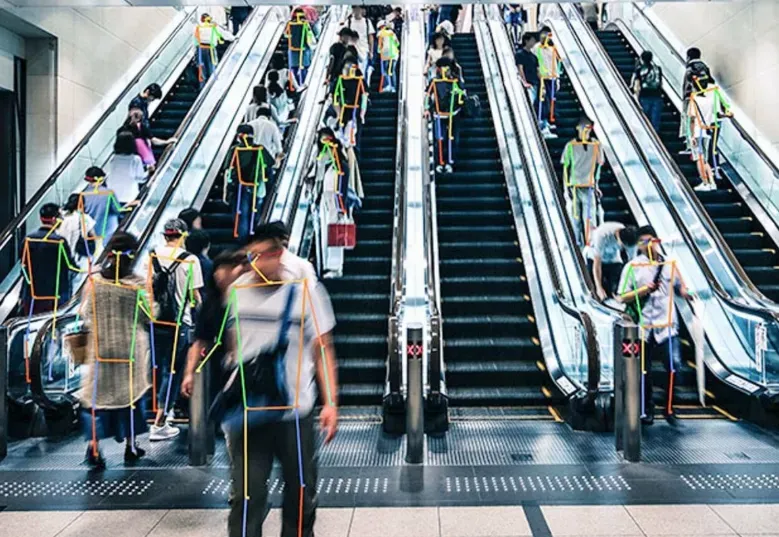
It comes from a Tokyo company called Asilla. Its behavior-recognition AI plugs into the surveillance cameras a building already has and watches for a specific kind of footage: someone pacing back and forth at the edge of a platform, someone standing too long by a high railing, someone drifting into a corner where customers never go. When the system flags one of these anomalous movement patterns, it alerts security and station staff — and in some locations triggers a PA announcement.
It has already stopped people
In one mall, the system flagged a man who had wandered into a non-customer area. A guard went to check; the man later admitted he had intended to jump. At another high-rise venue, a child stood by a railing for a long stretch. When a guard reached them, they discovered the child was carrying a suicide note.
The two cases share something important: neither person asked for help out loud. Their bodies gave them away first. Nobody announces "I'm going to jump" — but the pacing, the lingering, the slow drift toward an edge tend to show up before the words ever do. What the AI does is sift those few people out of dozens of camera feeds that no human guard could possibly watch all at once.
Trained on 7 million clips to recognize "abnormal" motion
How does a suicide-prevention system learn to read people? Since 2022, Asilla has worked with around 200 malls and institutions, training its behavior-recognition AI on roughly 7 million surveillance clips. Beyond suicide risk, the system can also spot someone who suddenly collapses, lies motionless for a long stretch, or gets into a physical fight. At bottom, it's learning a single thing: what abnormal movement looks like.
One AI reads your words; the other reads your motion
Just two months earlier, China's new rules on human-like AI interaction introduced a clause aimed squarely at self-harm. The regulations require that when a user tells an AI in conversation that they intend to hurt or kill themselves, the AI must respond with support measures and promptly contact a guardian or emergency contact. The backdrop is a tragedy from the US: in 2023, a 14-year-old American boy formed a long emotional dependence on a chatbot, mentioned suicidal thoughts twice, and ultimately took his own life.
One AI reads your words as you type; the other reads your movements as you walk. Both are trained on the same moment — the window just before a person makes a final decision, and whether there's still a chance to step in.
The cost: it has to watch everyone, all the time
Behavior recognition only works if the camera is watching every single person. To judge that one movement is "abnormal," the system first has to absorb everyone else's normal movements. Waiting at a station for a friend who's running late, leaning on a railing to take in the view, circling a mall because you can't find the exit — in theory, any of these ordinary behaviors could get tagged "suspicious."
Who confirms whether an alert is real? How should a guard approach after a false positive? Does the person under the AI's gaze even know they're being watched? These surveillance and privacy questions have no settled answers yet. Japan's current approach is to let the AI raise the alarm and leave the judgment to humans — the machine never acts on its own. Exactly where to draw that line is something every country will have to decide for itself.
An eye that never closes can save someone about to jump. It also records everyone merely passing through. Both are the work of the same eye.
References
Related
AI Voice Cloning Can Fake Your Family in Seconds — Here's the One Safe Word That Beats the Scam
Americans lost roughly $890 million to AI-related fraud last year, and AI voice-cloning scams are the fastest-growing slice of it. A few seconds of audio is all a scammer needs to clone a loved one's voice — and the FBI and experts admit even they can no longer reliably tell real from fake. Instead of trusting your own ears, lock in a few fixed defenses — starting with a family "safe word."
OpenAI Reboots Its Robotics Team: First to Help Build the World, Then a Personal Robot for Everyone
The company behind ChatGPT and Sora is quietly hiring its way back into robotics. Five years ago, OpenAI shut down its own robotics division and called the path a dead end.
AI 'Griefbots': Talking to the Dead Again, and the Uneasy Comfort of Digital Clones
Feed an AI a deceased person's chat logs and voice recordings and you get a conversational "digital clone" — what's now called a deathbot or griefbot. Some people find real healing in it; others worry it keeps the grieving from ever letting go.