OpenAI Reboots Its Robotics Team: First to Help Build the World, Then a Personal Robot for Everyone
The company behind ChatGPT and Sora is quietly hiring its way back into robotics. Five years ago, OpenAI shut down its own robotics division and called the path a dead end.
In late May, OpenAI CEO Sam Altman posted a hiring call: the company wants engineers in hardware, systems, and machine learning to "build robots that are useful to society."
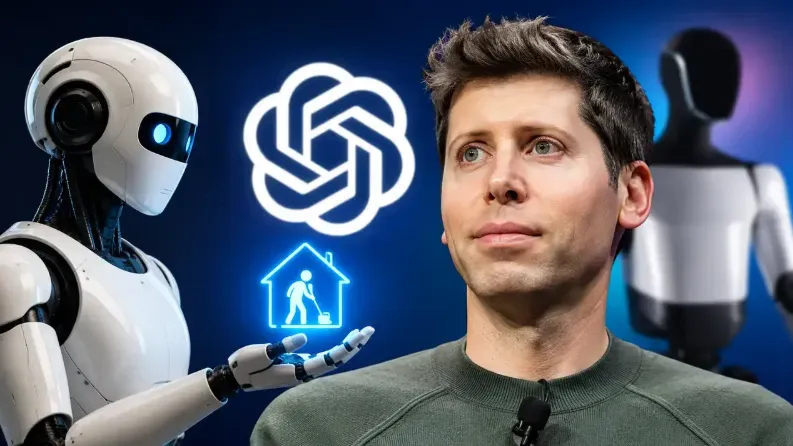
It sounds unremarkable — until you remember who's saying it. Five years ago, OpenAI was the company that shut its own robotics division down.
The reasoning at the time was blunt: robots weren't a necessary step toward more capable AI, and there simply wasn't enough data to train them. The team was disbanded, and the company poured everything into what became the globally ubiquitous ChatGPT.
Five years on, OpenAI is back in robotics.
A robotics team with an unusual lineage
This team wasn't conjured from nothing. It grew out of an internal research effort on "world simulation," and it absorbed a group of people who'd been working on Sora, OpenAI's video-generation model. Aditya Ramesh leads it.
Put simply: these are people who were already teaching AI what the real world looks like. Now they want to take AI off the screen and put it into that world.
What are the robots actually for?
Altman's pitch comes in two stages.
In the near term, the robots go help frontline workers build things.
The AI boom has set off a global scramble to build data centers, lay power grids, and stand up factories. That work is grueling, short-staffed, and especially starved for skilled labor. Robots would lend a hand on these sites first, taking on the repetitive, physically punishing parts.
In the long term, the picture he paints is far bigger: everyone owns a personal robot that does whatever they need.
Housework, hauling, the tedious physical chores. It sounds like a scene lifted from science fiction.
OpenAI isn't the only one chasing humanoids
Tesla's humanoid robot Optimus has made several public appearances, and companies like Figure are fighting for the same humanoid-robot turf.
By stepping directly into hardware — after a history of building only software — OpenAI just pushed that race a notch further.
Worth noting: outside observers still can't quite read OpenAI's true motive. One analysis argues the rush back into robotics isn't really about shipping a product soon. It's more likely a bid to collect real-world data through robots and feed that back to make the AI itself smarter.
Whatever ends up rolling off the line, one thing is clear: the AI we know — the one that only types back at us from a screen — is trying to grow hands and feet.
References
Related
9 of Every 10 Humanoid Robots Are Made in China — and It's Shaping Up to Be the Next EV-Scale Industry
Chinese humanoid-robot maker Unitree alone holds **32.3%** of the global market. In just two years, the price of a humanoid robot has fallen from that of a luxury car to that of a smartphone.
Google's $15 Billion India Data Center Drinks 4.1 Million Gallons of Water a Day — and Locals Are Pushing Back
Google has broken ground in Visakhapatnam, southern India, on its largest AI data center outside the United States, backed by a $15 billion, five-year commitment. The state of Andhra Pradesh has pledged roughly **₹2.2 trillion** in waivers and subsidies — and the campus's water demand is so heavy that local groundwater has fallen as much as 9 meters in a single year.
AI Surveillance Cameras That Spot Someone About to Jump — and Have Already Saved Two Lives in Japan
Tokyo startup Asilla has bolted behavior-recognition AI onto ordinary surveillance cameras, training it to flag people who pace at a platform edge or linger by a rooftop railing and alert security the moment something looks wrong. The AI video-analytics system was trained on roughly 7 million clips and now runs across about 40 stations and malls in Tokyo and Kanagawa, where it has already intercepted at least two people.