Google's $15 Billion India Data Center Drinks 4.1 Million Gallons of Water a Day — and Locals Are Pushing Back
Google has broken ground in Visakhapatnam, southern India, on its largest AI data center outside the United States, backed by a $15 billion, five-year commitment. The state of Andhra Pradesh has pledged roughly **₹2.2 trillion** in waivers and subsidies — and the campus's water demand is so heavy that local groundwater has fallen as much as 9 meters in a single year.
On April 28, 2026, Google broke ground in Visakhapatnam, India, on the largest AI data center campus it has ever built outside the United States — 480 acres, with planned capacity reaching 6 gigawatts by 2029. Its partners include the Adani Group, run by India's richest man, and telecom giant Bharti Airtel.
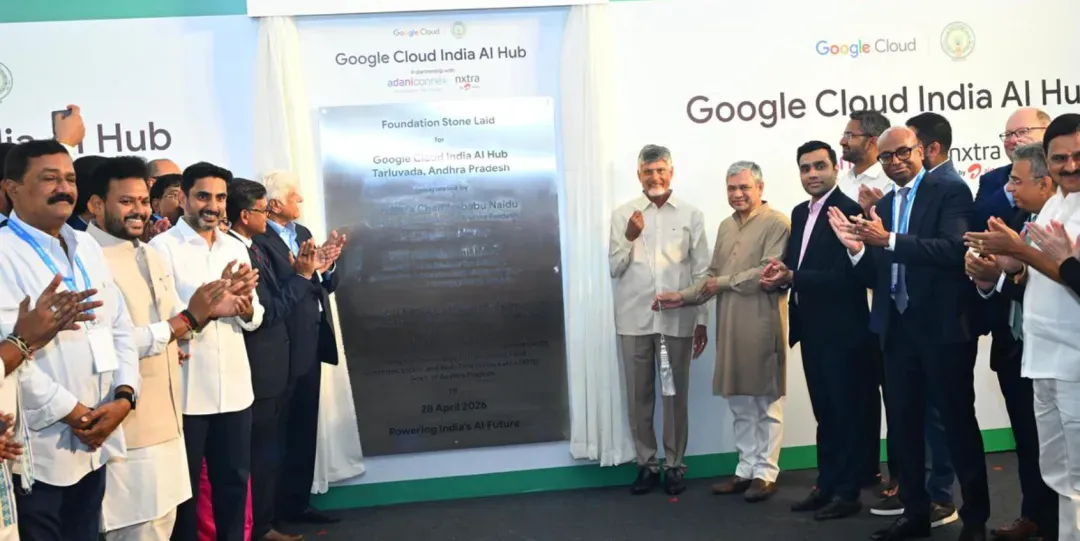
The Modi government has placed the project at the center of its "Developed India" agenda. But the controversy around the data center hasn't let up since the day the deal was signed — and it comes down to one resource: water.
The subsidy package Andhra Pradesh offered
To land Google, the state laid out a long list of incentives:
- Land: priced at a 25% discount to market
- Stamp duty: fully waived
- Industrial water: 25% cheaper
- Power: electricity duty waived, plus a ₹1-per-unit rebate — roughly a 15% discount on industrial power
- State GST: fully reimbursed during construction, capped at ₹224.5 billion
Power subsidies run for 15 years, water subsidies for 10. Over a 20-year horizon, the total package of waivers and subsidies comes to about ₹2.2 trillion — roughly $26 billion at current exchange rates.
The Human Rights Forum (HRF) put its objection bluntly: that money could have funded healthcare, education, and rural development instead.
2.7 to 4.1 million gallons of water a day
This is the figure hardest to dodge — and a textbook example of an AI data center's thirst.
By industry estimates, a 1-gigawatt AI data center needs 2.7 to 4.1 million gallons of water a day for cooling — about 10 to 15.5 million liters. For perspective, a single ChatGPT exchange is estimated to consume around half a liter.
And Visakhapatnam's water budget is anything but generous.
Monitoring data from India's Central Ground Water Board shows that in the city's Yendanda area, the groundwater table fell from 19.62 meters in April 2025 to 28.71 meters in April 2026 — a drop of more than 9 meters in a single year. Other parts of the city declined between 0.61 and 9.14 meters over the same period, and groundwater in the Rambilli area is already classified as severely polluted.
Former Union Power Secretary EAS Sarma asked the obvious question: "When local reservoirs can barely meet the needs of residents and existing industry, how can Andhra Pradesh supply 4.1 million gallons a day to a single data center?"
He has written to India's environment ministry seeking to revoke the project's environmental clearance, arguing the approval violated statutory procedure and bore the marks of political interference.
US cities have already said no to projects like this
Sarma also drew a pointed comparison: in the United States, several communities have rejected Google data center proposals over exactly these water and power concerns.
The reasoning was the same everywhere — local resources simply can't sustain compute facilities of this scale.
The jobs math doesn't add up
The state's pitch touts 188,000 jobs.
The Human Rights Forum's breakdown tells a very different story. Modern AI data centers are heavily automated; permanent roles typically number only in the low hundreds and require specialized skills. The rest are mostly short-term construction jobs, followed by low-wage cleaning and maintenance work.
Land acquisition is contested, too. Local farmers were asked to "voluntarily" surrender their land through a "land pooling" mechanism, with little genuine community consultation.
The bottom line: the profits flow to a multinational's shareholders, while the costs — in water, power, and land — stay local.
References
- 01https://www.thenewsminute.com/andhra-pradesh/inside-the-subsidies-for-googles-vizag-data-centre-amid-andhra-karnataka-spar
- 02https://humanrightsforum.org/google-data-center-represents-a-looming-environmental-economic-disaster-hrf/
- 03https://www.freepressjournal.in/amp/tech/how-can-andhra-provide-millions-of-gallons-a-day-when-local-reservoirs-barely-suffice-ex-ias-officer-flags-environmental-violations-in-googles-vizag-data-centre-project
- 04https://countercurrents.org/2026/04/call-to-revoke-flawed-environmental-clearances-for-vizag-data-centre-projects/
- 05https://scroll.in/article/1092827/water-energy-use-concerns-grow-with-more-india-data-centres-in-the-pipeline
Related
OpenAI Reboots Its Robotics Team: First to Help Build the World, Then a Personal Robot for Everyone
The company behind ChatGPT and Sora is quietly hiring its way back into robotics. Five years ago, OpenAI shut down its own robotics division and called the path a dead end.
AI Surveillance Cameras That Spot Someone About to Jump — and Have Already Saved Two Lives in Japan
Tokyo startup Asilla has bolted behavior-recognition AI onto ordinary surveillance cameras, training it to flag people who pace at a platform edge or linger by a rooftop railing and alert security the moment something looks wrong. The AI video-analytics system was trained on roughly 7 million clips and now runs across about 40 stations and malls in Tokyo and Kanagawa, where it has already intercepted at least two people.
AI Voice Cloning Can Fake Your Family in Seconds — Here's the One Safe Word That Beats the Scam
Americans lost roughly $890 million to AI-related fraud last year, and AI voice-cloning scams are the fastest-growing slice of it. A few seconds of audio is all a scammer needs to clone a loved one's voice — and the FBI and experts admit even they can no longer reliably tell real from fake. Instead of trusting your own ears, lock in a few fixed defenses — starting with a family "safe word."