Why Military AI Now Worries Generals More Than Nuclear Weapons: It's Too Fast for Humans to Decide
At the Shangri-La Dialogue in Singapore in late May, several defense experts ranked the risks of military AI ahead of nuclear weapons. What truly alarms them is that AI is compressing military decisions to a speed the human brain simply can't keep up with.
Nuclear weapons have been with us for 80 years, long enough that we treat them as the ultimate sword hanging over humanity. But at an international defense forum that wrapped up in late May, when experts debated what's most dangerous, the answer had shifted.
Ranked ahead of nuclear weapons: military AI.
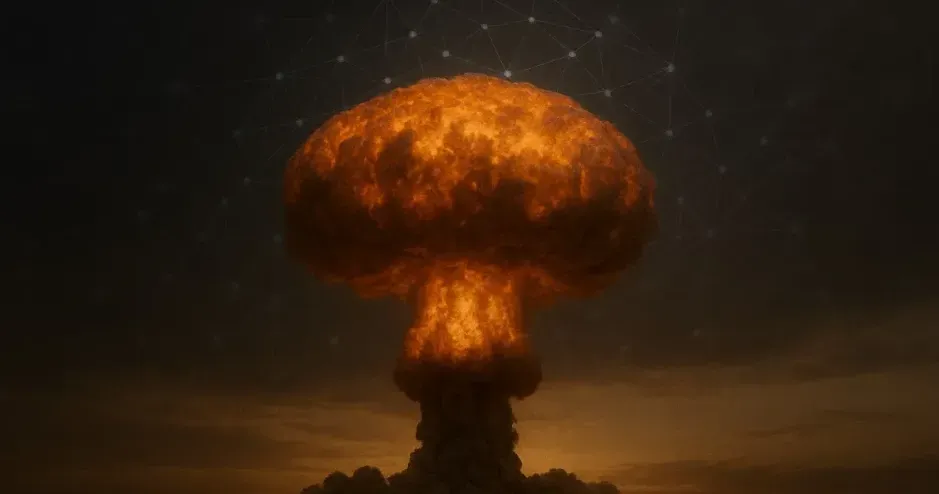
A surprising consensus
The forum was the Shangri-La Dialogue, held in Singapore from May 29 to 31 — one of Asia's largest defense and security gatherings, drawing top military officials and strategists from more than 40 countries.
In a session on "strategic stability," the panelists were strikingly aligned: the risks posed by military AI now eclipse those of nuclear weapons.
Lieutenant General Numan Zakaria of the Pakistan Army put it plainly. When AI squeezes reaction time too short, "people don't have enough time to make sense of the situation" — and the result is that "humans take irrational, extreme actions."
Notice what they are not afraid of: AI turning into a sci-fi Skynet. The real worry is far more mundane. It comes down to a single word: speed.
Why "too fast" is such a serious problem
Militaries rely on a classic decision model called the OODA loop: observe, orient, decide, act.
When humans run those four steps, it's slow — but slow leaves room. A missile takes minutes to travel from launch to impact, and in those minutes the officer on duty can double-check, call to confirm, or call the whole thing off. More than one near-miss nuclear crisis was ultimately defused because a human hit the brakes at the last possible moment.
What AI does is compress those four steps into seconds — or less.
The machine observes for you, judges for you, and recommends the next strike. How fast does it get? Fast enough that humans are left only to nod along. Experts call this war at "machine speed" — decisions made so quickly that the human brain can't get a word in.
Once the tempo reaches that point, the danger begins: the machine can miscalculate, mistaking a flock of geese for an incoming squadron. The human, who was supposed to be the firewall at the cliff's edge, fails — simply because there's no time to react. By the time anyone catches up, events may already be unstoppable.
Why military AI is trickier than the bomb
The logic of nuclear weapons is, paradoxically, slow. Their deterrence rests on "no one dares strike first," and that standoff buys time to think and to negotiate.
AI inverts the whole equation. Its entire appeal is speed. Whoever's system reacts a second slower may lose — so every country feels pressure to hand more and more of the decision over to the machine. That race to be faster is exactly where things are most likely to go wrong.
There's a more immediate layer, too: AI is mass-producing information that's hard to tell true from false. Slip a piece of fabricated intelligence or a doctored clip into a tense standoff, add the pressure to decide within seconds, and the odds of a catastrophic misjudgment only climb.
It isn't all bad news
The good news is that the problem is now squarely on the table.
Several nuclear powers — the US, the UK, and France — have in recent years publicly committed to one red line: the decision to launch nuclear weapons must be made by a human, never delegated to AI. International dialogue on "responsible use of AI in the military domain" is ongoing.
Keeping AI away from that single most dangerous button is the minimum consensus everyone can currently reach.
The Shangri-La Dialogue produced no final answer. But it at least stated the problem clearly: what keeps these generals up at night is whether we've left ourselves those few minutes to call it off.
References
- 01https://www.bloomberg.com/news/articles/2026-05-30/ai-dangers-eclipse-nuclear-weapons-at-singapore-defense-forum
- 02https://www.chinatechnews.com/2026/05/31/122782-at-summit-ai-dangers-dwarf-nuclear-concerns
- 03https://www.iiss.org/events/shangri-la-dialogue/shangri-la-dialogue-2026/
- 04https://www.sipri.org/publications/2025/sipri-insights-peace-and-security/impact-military-artificial-intelligence-nuclear-escalation-risk
- 05https://www.icanw.org/what_are_the_main_risks_ai_and_nuclear_weapons
Related
AI Surveillance Cameras That Spot Someone About to Jump — and Have Already Saved Two Lives in Japan
Tokyo startup Asilla has bolted behavior-recognition AI onto ordinary surveillance cameras, training it to flag people who pace at a platform edge or linger by a rooftop railing and alert security the moment something looks wrong. The AI video-analytics system was trained on roughly 7 million clips and now runs across about 40 stations and malls in Tokyo and Kanagawa, where it has already intercepted at least two people.
AI Voice Cloning Can Fake Your Family in Seconds — Here's the One Safe Word That Beats the Scam
Americans lost roughly $890 million to AI-related fraud last year, and AI voice-cloning scams are the fastest-growing slice of it. A few seconds of audio is all a scammer needs to clone a loved one's voice — and the FBI and experts admit even they can no longer reliably tell real from fake. Instead of trusting your own ears, lock in a few fixed defenses — starting with a family "safe word."
OpenAI Reboots Its Robotics Team: First to Help Build the World, Then a Personal Robot for Everyone
The company behind ChatGPT and Sora is quietly hiring its way back into robotics. Five years ago, OpenAI shut down its own robotics division and called the path a dead end.